
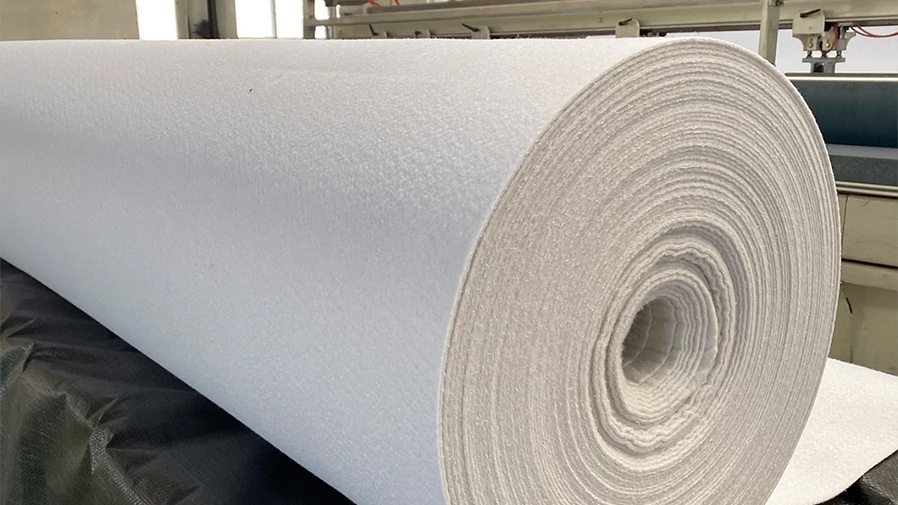
Long-Fiber Needle-Punched Geotextile: Made from polymer (mainly polyester) chips, which are melted, metered, extruded through a spinneret, and then stretched to form continuous long fibers (theoretically infinite in length). These fibers are then needle-punched and reinforced after oriented or random web formation.
Short-Fiber Needle-Punched Geotextile: Typically made from recycled polyester materials or virgin polyester cut into fixed-length short fibers (usually 40-100mm). These fibers are opened, mixed, carded into a web, and then needle-punched and reinforced.
Mechanical Properties and Structural Stability:
Long-Fiber Geotextile: Due to the continuous fibers, a complete and stable three-dimensional network structure is formed within the fabric. Its tensile strength, tear strength, bursting strength, and creep performance are significantly better than short-fiber geotextiles of the same basis weight, and it exhibits better isotropy and more predictable mechanical behavior. It has high structural stability under long-term loads.
Short-Fiber Geotextile: Its strength depends on the friction and entanglement between short fibers; it is a friction-type material. In the initial stage of stress, fiber rearrangement occurs, resulting in a lower initial modulus. Under long-term loads, the structure is prone to adjustment, leading to a relatively higher risk of strength and deformation performance degradation.
Hydraulic Properties (Filtration/Drainage)
Long-fiber geotextiles: Pore size distribution is more uniform, continuous, and stable. Under long-term pressure and water flow, the pore structure maintains good integrity, providing more durable and reliable filtration, and superior anti-clogging performance.
Short-fiber geotextiles: Pore uniformity is relatively poor. Under pressure, the fiber web may reorganize, resulting in lower long-term stability of hydraulic parameters (such as permeability coefficient and characteristic pore size) compared to long-fiber geotextiles.
Durability and Environmental Adaptability
Long-fiber geotextiles: Typically use high-quality virgin raw materials, with uniformly distributed additives (such as UV stabilizers and anti-aging agents). Their continuous structure more effectively resists UV radiation, chemical and biological erosion, resulting in a longer design service life.
Short-fiber geotextiles: Raw material sources may be complex, making performance consistency control more difficult. Short fibers have many ends, making them more susceptible to invasion by external factors, thus limiting their durability.
Thank you very much for writing to us. Please leave your message and contact information, we will reply to you within 24 hours.