
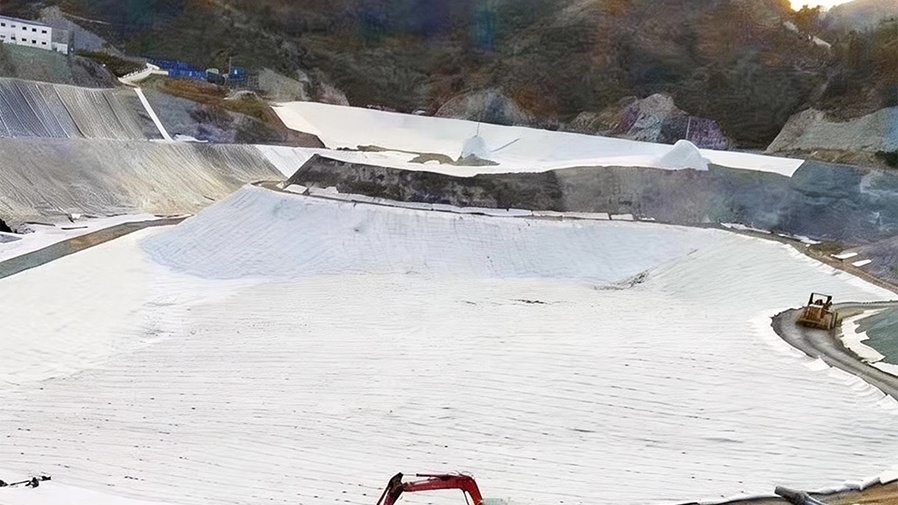
I. Core Functions: High-performance seepage prevention and sealing
Low permeability barrier: Bentonite (mainly composed of montmorillonite) expands to 10-15 times its original volume upon contact with water, forming a dense gel-like substance.
This process effectively fills the pores and cracks within the material and the underlying substrate, resulting in an extremely low permeability coefficient (typically on the order of 10⁻⁹ ~ 10⁻¹¹ cm/s), comparable to or even superior to compacted clay, but with a thinner thickness and faster construction.
Self-healing ability (key advantage):
This is GCL's most unique function. If the material suffers localized damage or puncture due to construction or settlement, the surrounding bentonite will migrate upon contact with water and fill the damaged area, automatically "healing" the leakage channel, greatly improving the reliability and safety redundancy of the seepage prevention system.
II. Key Roles in Engineering
As the primary impermeable layer (for projects with lower requirements):
In some projects with relatively low impermeability requirements (such as artificial lakes and landscape water bodies), GCL can be used alone as the primary impermeable layer.
As an "intelligent" backup layer in composite impermeable systems (core application):
In high-risk projects such as hazardous waste landfills, tailings ponds, and crude oil tank farms, GCL is often used in combination with HDPE geomembranes to form a dual impermeable system of "flexible membrane + self-healing clay layer".
The division of labor is as follows:
HDPE membrane: As the first rigid primary impermeable layer, it provides high-strength impermeability.
GCL: As the second line of defense, it provides self-healing backup. Once the primary membrane experiences even a minor leak, the GCL can immediately activate its sealing function, acting as an "invisible insurance" for the project.
Strong adaptability to deformation: Compared to rigid concrete or brittle clay layers, GCL has good flexibility, better adapting to uneven settlement of the foundation and less prone to penetrating cracks.
Convenient construction, saving costs and space: Roll-type production allows for fast laying. Unlike compacted clay layers, it does not require large equipment, strict moisture content control, or thick filling, significantly saving construction time, space, and costs.
Thank you very much for writing to us. Please leave your message and contact information, we will reply to you within 24 hours.